KESHER: AI-Powered Customer Service, on Every Channel, with a Human When Needed
KESHER is an AI-powered service platform for organizations that serve a broad public. Customers ask, request or report in their own words, on the website, on WhatsApp, by voice or by phone, and KESHER understands what they need: it answers from the organization's approved sources, shows their personal information after identity verification, opens a request or books an appointment, and hands over to an agent with full context when needed.
 Blog
Min read
Why we built it
Customers who want to get something done with a large organization today need to know where to turn: which page on the website, which department, the personal area or the call center. The information exists, but it is scattered across hundreds or thousands of pages and documents, and personal services sit in separate systems. The result is familiar to every service organization: long searches, calls to the call center, and repetitive questions that keep agents busy.
KESHER turns all of this into a single conversation. Customers don’t need to know where to turn: they say what they need, and the system routes the request to the right service, answers from the organization’s content, and always leaves a path to a human.
What the system does
Answers from the organization’s content, with sources
KESHER crawls and indexes the organization’s website, documents and content management system, and answers only from them. Every answer includes a link to the source page and the date the information was last updated. When there is no authoritative source, the bot says it doesn’t have an answer, doesn’t guess, and offers an agent, a callback or a request to the call center.
The personal area, inside the conversation
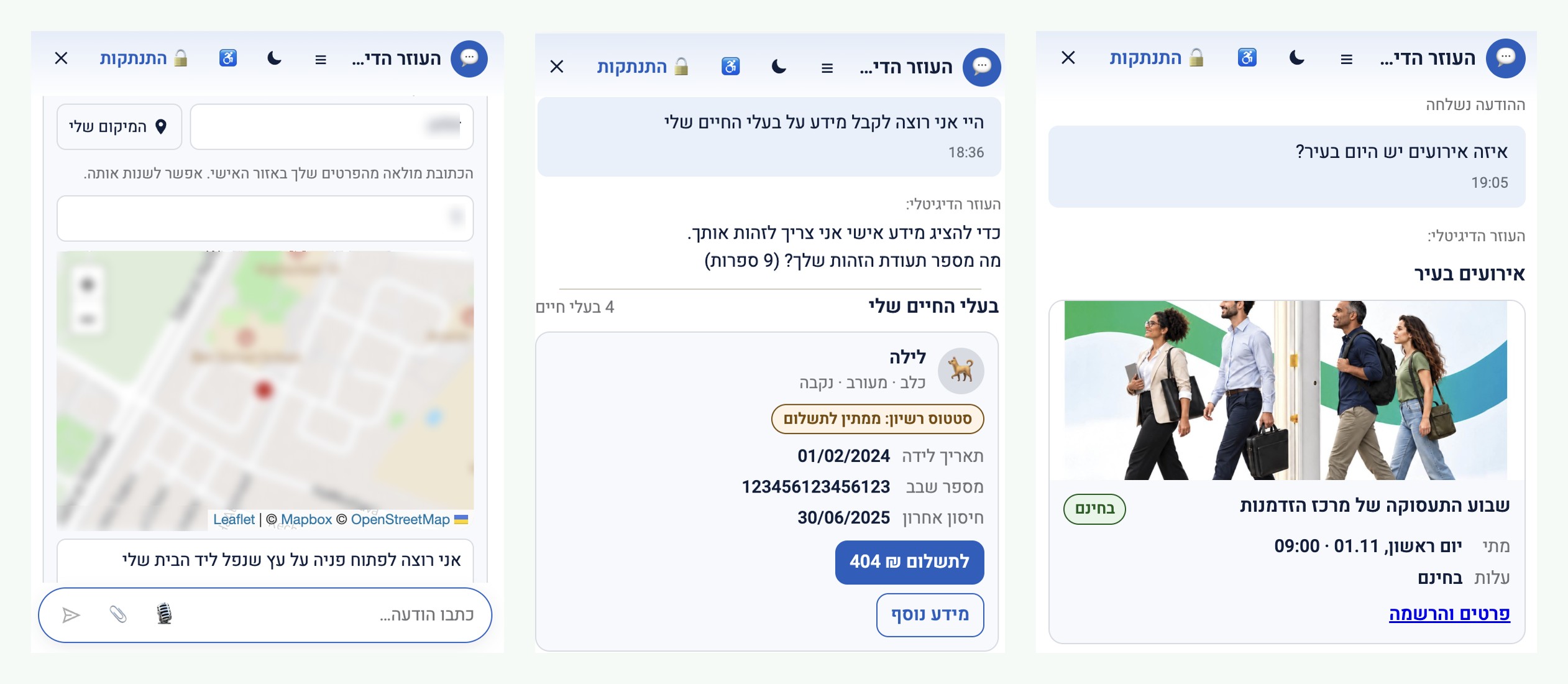
After identity verification with a one-time code against the organization’s CRM, customers get in the conversation exactly what they would get in the personal area, under the same rules and wording: balances and accounts, payments and receipts, request and inquiry status, appointments and meetings, and the data registered to them. General information is open to everyone, and personal information is shown only after identity verification. In a municipality, for example, this includes property tax, education payments, parking tickets and registered pets.
From request to action
A request written in free text becomes a classified request form: topic, address or details filled in from the personal area, a location on the map and the option to attach a photo. The request is sent only after the customer approves it, and is routed to the right call center or department in the organization’s systems. In the same way, customers book appointments: they choose a department, topic, channel (in person, phone or video), day and time, and the bot books the meeting and sends a confirmation.
An interface built during the conversation
The bot doesn’t just return text. It builds cards, buttons, forms and filters inside the conversation, based on the question: event or product cards with an image, date, cost and registration link; a card for each item in the personal record with its status and a payment button; and a form that is filled in field by field, with validation and submission for approval.
One channel or four
● Organization website: a chat with cards, forms and buttons, styled with the organization’s design.
● WhatsApp: the same capabilities, in short lines and buttons.
● Voice on the website: talk to the bot in Hebrew, English or Russian, including filling in forms by voice, while the screen displays the results in parallel.
● Phone bot: answers incoming calls to the call center, and makes outgoing calls: reminders, updates on closed requests, callbacks and surveys.
At every stage and on every channel, customers can ask for an agent and choose a call center. The conversation is handed over to the agent with full context, and the customer doesn’t have to start over.
The call center console
Agents work in a single console that shows all conversations, from all channels, in real time. When an agent joins a conversation, they see everything that has happened in it up to that moment.
● Agent Copilot: a suggested answer for every inquiry, with tracking of how many suggestions were sent without editing.
● Anomaly investigation: a spike in inquiries on a specific topic? With one click, the AI explains what happened, the likely causes and the recommended next steps.
● Inquiry map: inquiries by location, with the leading topics, without exposing full addresses.
● Improvement loop: questions the bot couldn’t answer become tasks for the content team.
● Outbound campaigns: upload a recipient file, and the bot reaches out to them.
Responsible AI, security and privacy
● Grounding gates: an answer without a source citation, or with weak grounding, is blocked before it is sent.
● Transparency: the bot identifies itself as an automated system and states that the conversation is recorded.
● Privacy: personal information only after identity verification, and identifying details are never sent for translation. The design includes compliance with Amendment 13 to the Israeli Privacy Protection Law.
● Accessibility: full keyboard navigation, screen reader support and real buttons for quick replies.
● Data residency: static data in Azure Israel Central, and AI processing in Sweden Central.
Who it's for
● Organizations with a service call center: fewer repetitive questions for agents, inquiries that arrive classified and complete, and agents who join the conversation with full context.
● Organizations with a customer personal area: the information and actions of the personal area are also available in conversation, on the website, on WhatsApp and by phone.
● Municipalities and public bodies: service for residents and citizens, connected to the website, the personal area and the CRM.
● Digital and service managers: a complete picture of what customers are asking, where content is missing, and what needs attention.
How it's built
KESHER is built on Azure AI Foundry and Azure AI Search, and connects to the organization’s systems: CRM (for example Dynamics 365), the content management system and website, WhatsApp and identity management (Entra ID). The system is deployed on top of the existing website: the engine crawls and indexes the website, documents and content management system, and the bot takes on the organization’s design, within a secure Azure infrastructure. Every conversation is logged in the organization’s CRM.
Already in the field
KESHER is running in a pilot at a leading municipality in central Israel: a bot on the website, on WhatsApp and in the call center console, connected to the municipality’s Dynamics 365.
Want to see it on your organization's content?
We’d be happy to demo KESHER on your organization’s website and services, and show how a customer gets an answer, personal information or an open request, in a single conversation.
To schedule a demo: [email protected] · zooz-tech.co.il/products/kesher